
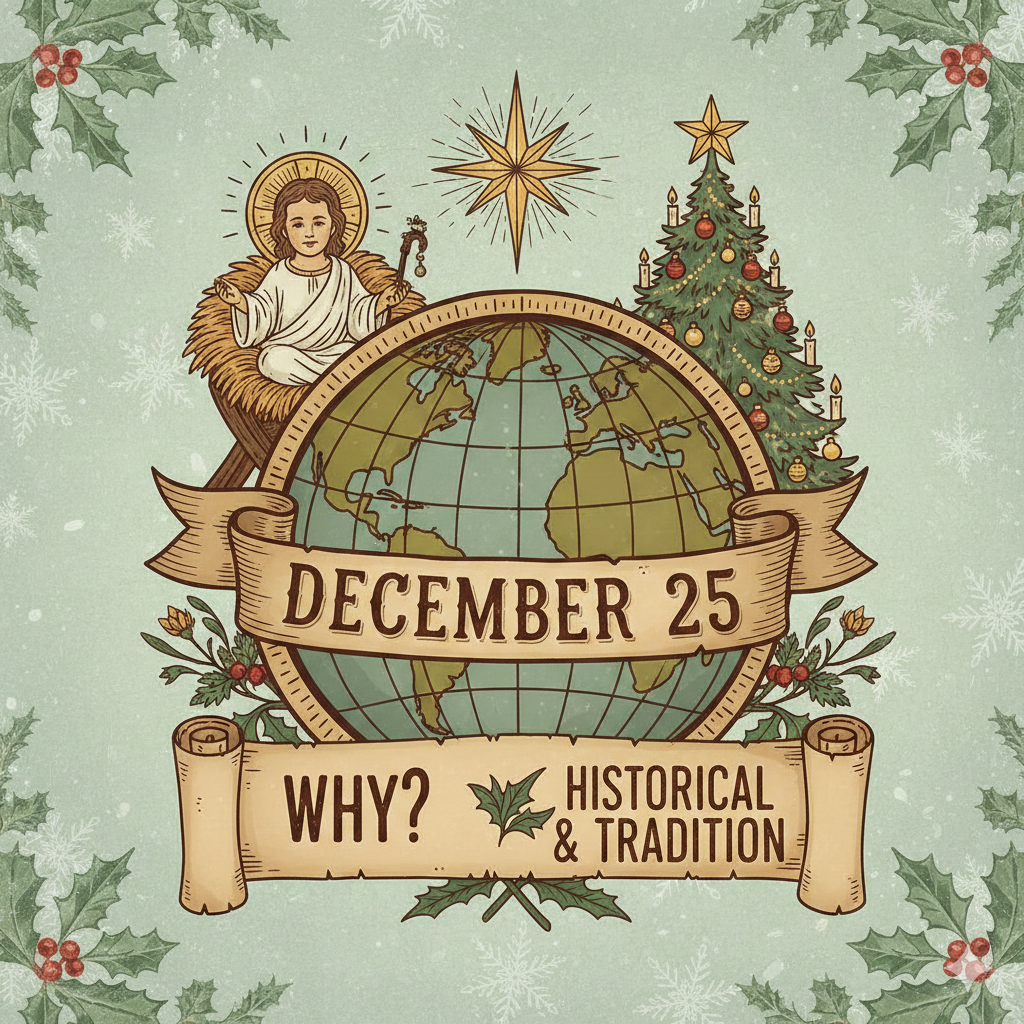
Christmas is one of the most widely celebrated festivals in the world, observed by billions of people across cultures, nations, and traditions. Every year, on 25 December, homes light up, churches fill with prayers, streets echo with carols, and families come together to celebrate the birth of Jesus Christ. Yet a question often arises: why exactly is Christmas celebrated on 25 December when the Bible does not mention a specific date for Jesus’ birth?
The answer lies in a fascinating mix of theology, Roman history, astronomy, politics, and cultural adaptation. This article explains, with real historical accuracy, how and why 25 December became Christmas Day,
The Biblical Silence on Jesus’ Birth Date
One of the most important facts to understand is that the Bible never mentions the exact date of Jesus Christ’s birth. The Gospels of Matthew and Luke describe the circumstances of Jesus’ birth—Mary, Joseph, Bethlehem, shepherds, and angels—but they do not record a calendar date.http://www.truthfrontier.com
Early Christians were far more focused on Jesus’ death and resurrection than on celebrating birthdays. In fact, birthday celebrations were not common religious practices in early Christianity. As a result, for the first few centuries, Christians did not celebrate Christmas at all. http://www.xmas.com
Early Christian Attitudes Toward Birthdays
In the ancient world, birthdays were often associated with pagan rulers and gods, not with spiritual leaders. Roman emperors celebrated their birthdays as public festivals, which made early Christians uncomfortable with the idea.
Some early Christian writers even argued that celebrating birthdays was a pagan tradition and therefore inappropriate. This explains why Christmas as a festival developed much later, several centuries after Jesus’ lifetime.
The Roman Empire and the Winter Solstice
To understand the choice of 25 December, we must look at ancient Roman culture.
The Winter Solstice Connection
The winter solstice, occurring around 21–22 December, is the shortest day and longest night of the year in the Northern Hemisphere. After this point, days gradually begin to grow longer.
Ancient civilizations saw this as a powerful symbol of rebirth, renewal, and victory of light over darkness. The Romans celebrated this period with festivals, feasting, and public holidays.
Saturnalia: Rome’s Most Popular Festival
One of the most important Roman festivals was Saturnalia, dedicated to Saturn, the god of agriculture.
Features of Saturnalia
Celebrated between 17–23 December
Included feasting, gift-giving, singing, and role reversal
Slaves were temporarily treated as equals
Public joy and relaxation from social rules
Many traditions associated with Christmas—such as gift exchange, decorations, and public celebration—closely resemble Saturnalia customs.

Sol Invictus and 25 December
Another crucial Roman festival was dedicated to Sol Invictus, meaning “the Unconquered Sun.”
Birth of the Sun God
In 274 CE, Roman Emperor Aurelian officially declared 25 December as the birthday of Sol Invictus. The sun god symbolized strength, power, and eternal light—qualities that resonated deeply in Roman society.
As Christianity grew within the Roman Empire, this date already held enormous religious importance.
Christianity’s Strategic Adaptation
By the 4th century, Christianity was spreading rapidly across the Roman Empire. Church leaders faced a major challenge: how to convert pagan populations without completely erasing their cultural traditions.
Replacing Pagan Festivals
Instead of banning popular pagan festivals, the Church chose a strategic path—reinterpretation.
The “birth of the sun” became the birth of Jesus Christ, the “Light of the World”
Pagan celebrations were replaced with Christian meanings
Familiar dates made conversion easier for the masses
This approach allowed Christianity to grow while maintaining social stability.
The First Recorded Christmas on 25 December
The earliest known reference to Christmas being celebrated on 25 December dates back to 336 CE in Rome, during the reign of Emperor Constantine.
Constantine was the first Roman emperor to convert to Christianity, and his rule marked a turning point for the religion. Under his influence, Christianity gained official recognition, and Christian festivals became more structured.
By the end of the 4th century, 25 December was widely accepted as Christmas Day in Western Christianity.
Theological Symbolism Behind 25 December
Beyond politics and culture, Christian theologians also developed symbolic reasoning to support the date.
The March 25 Theory
Some early Christians believed that:
Jesus was conceived on 25 March (the date of the Annunciation)
Adding nine months places his birth on 25 December
This belief connected Jesus’ conception and crucifixion to the same date, emphasizing divine perfection and symmetry.

Differences Between Western and Eastern Christianity
Not all Christians initially agreed on 25 December.
January 6 and Epiphany
Eastern Christian churches originally celebrated Jesus’ birth on 6 January, known as Epiphany, which focused on Jesus’ divine revelation.
Over time:
Western Christianity adopted 25 December
Eastern traditions gradually accepted it, though some Orthodox churches still follow the Julian calendar, celebrating Christmas on 7 January (Gregorian calendar)
Spread of Christmas Across the World
As Christianity expanded beyond Europe, 25 December traveled with it.
Global Adoption
Missionaries introduced Christmas to Africa, Asia, and the Americas
Local cultures blended Christmas with indigenous traditions
Despite climate and cultural differences, the date remained unchanged
Today, Christmas is celebrated in tropical regions, deserts, and snowy lands alike—always on 25 December.
Modern Christmas: Faith, Culture, and Commerce
Over centuries, Christmas evolved beyond a purely religious festival.
Cultural Transformations
Santa Claus developed from St. Nicholas traditions
Christmas trees originated from German customs
Gift-giving became a central global practice
While commercial aspects have grown, the core symbolism of hope, peace, and light remains central.
Is 25 December Jesus’ Actual Birthday?
Historically speaking, there is no concrete evidence that Jesus was born on 25 December.
Scholars suggest:
Jesus may have been born in spring or early autumn
Shepherds tending flocks at night suggest warmer seasons
However, the importance of Christmas lies not in historical precision, but in spiritual meaning.
The Deeper Meaning of Celebrating on 25 December
Christmas on 25 December represents:
Light overcoming darkness
Hope during the coldest time of year
Renewal, peace, and divine presence
By choosing a date already rich with symbolism, Christianity transformed an ancient celebration of the sun into a celebration of spiritual light.

Conclusion: Why 25 December Truly Matters
Christmas is celebrated on 25 December not because it is historically proven as Jesus’ birthday, but because it reflects a powerful fusion of faith, culture, and history.
The date emerged from:
Roman winter festivals
The birth of Sol Invictus
Strategic Christian adaptation
Deep theological symbolism
Over time, 25 December became a universal symbol of love, hope, generosity, and light. Whether celebrated religiously or culturally, Christmas continues to unite humanity around shared values—making the date meaningful far beyond its historical origins.